
Is your student work ready?
Whether students plan to attend college or trade school, join the military, or enter the workforce after high school, becoming work ready is an important step before graduation. Students can demonstrate that they are ready for work by passing the Michigan Work Readiness Assessments.
What does work ready mean?
Being work ready means that students can apply the foundational academic skills to real-world situations and workplace tasks. For example, students can:
- Use math skills to calculate the volume of a container needed to ship pallets of materials.
- Use reading skills to identify essential information in a material safety data sheet.
- Use data analysis skills to interpret charts and graphs showing sales and marketing trends.
Passing the assessments results in a National Work Readiness Credential
When students pass the Work Readiness Assessments and earn their National Work Readiness Credential – Academic Skills, they can show employers, educators, and training providers that they are ready to work. Students also receive a digital version of their credential that can be shared online.
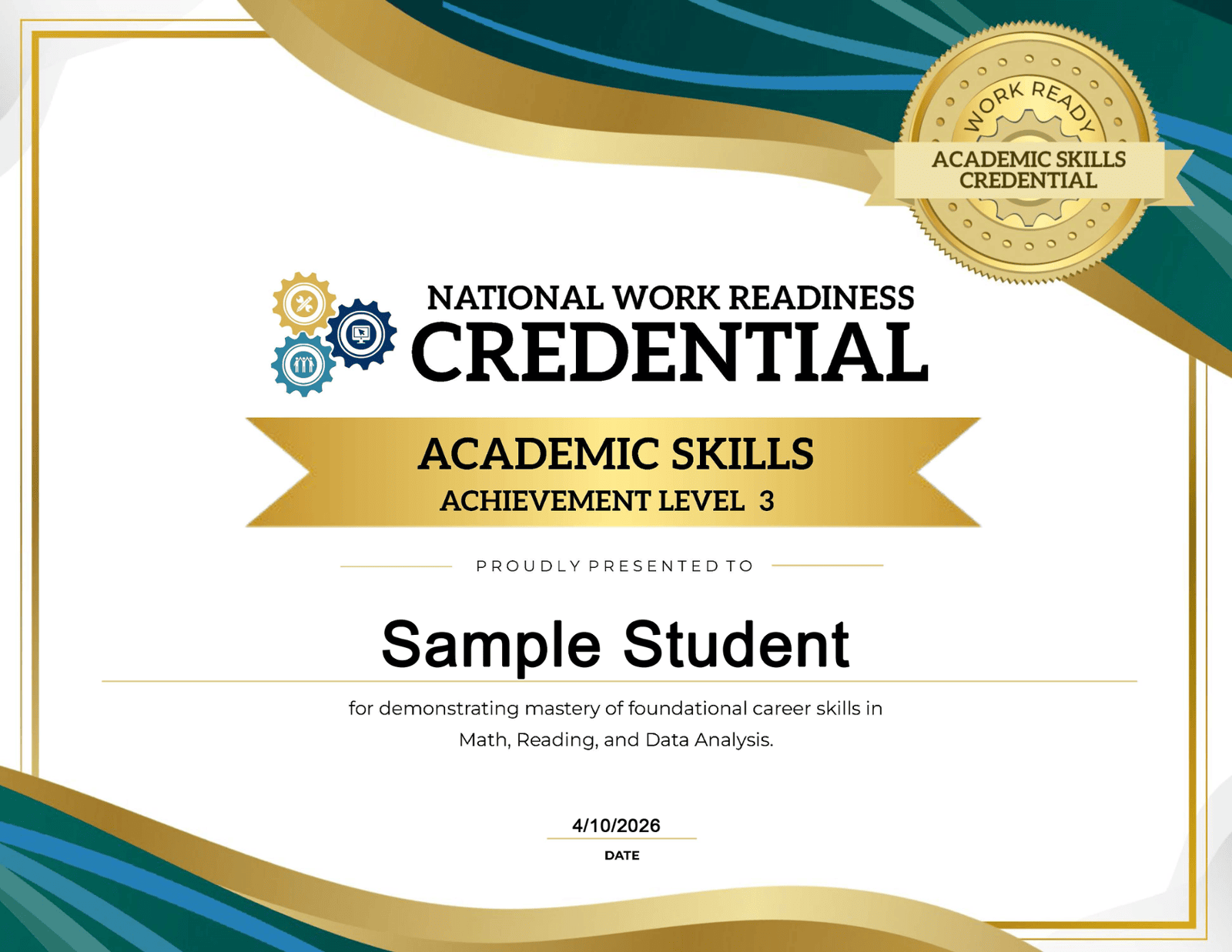
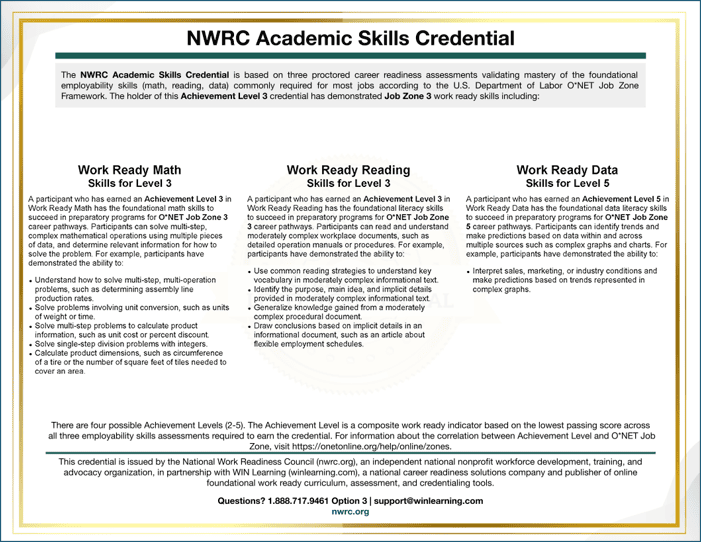
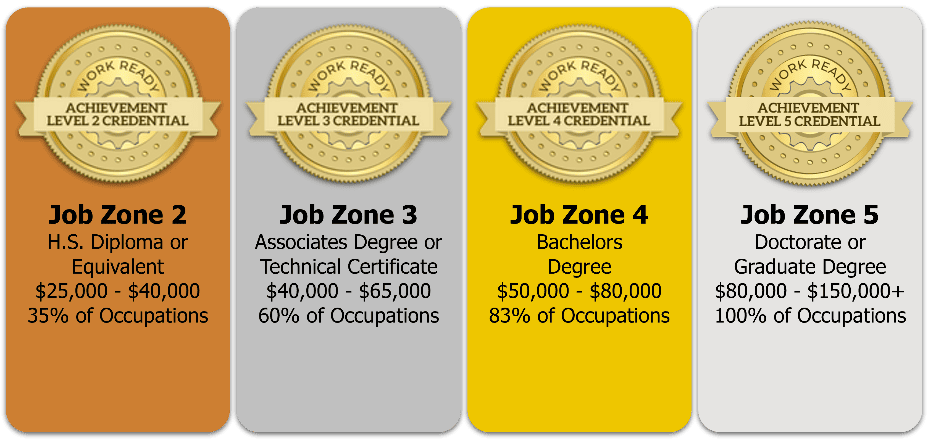
The Achievement Level that a student earns reflects the O*NET Job Zones that match their academic skills. Earning Achievement Level 2 or higher shows a student's readiness to pursue occupations across corresponding Job Zones in the U.S. Department of Labor’s O*NET occupational database.
How to earn the National Work Readiness Credential – Academic Skills
To earn the National Work Readiness Credential, students must score an Achievement Level 2 or higher on each assessment:
Work Ready Math measures ability to use mathematical reasoning skills to solve real-life workplace problems. Work Ready Reading measures ability to read, understand, and interpret written workplace text such as memos, schedules, company policies, and technical manuals. Work Ready Data measures ability to understand and interpret workplace data presented in forms, workflows, diagrams, charts, and graphs.
Benefits of being work ready before high school graduation
Earn a nationally recognized credential: Students who meet the assessment requirements receive the National Work Readiness Credential, which they can include on job applications and résumés to demonstrate workplace readiness.
Demonstrate real-world skills: The assessments measure foundational skills used in everyday workplace settings.
Open doors to rewarding careers: Employers and trade unions, including those in electrical, bricklaying, and heavy-equipment fields, use these scores when selecting candidates for well-paying jobs and apprenticeships.
Stand out in college and beyond: Students can leverage the credential to strengthen applications for competitive internships and jobs during college and after graduation.